

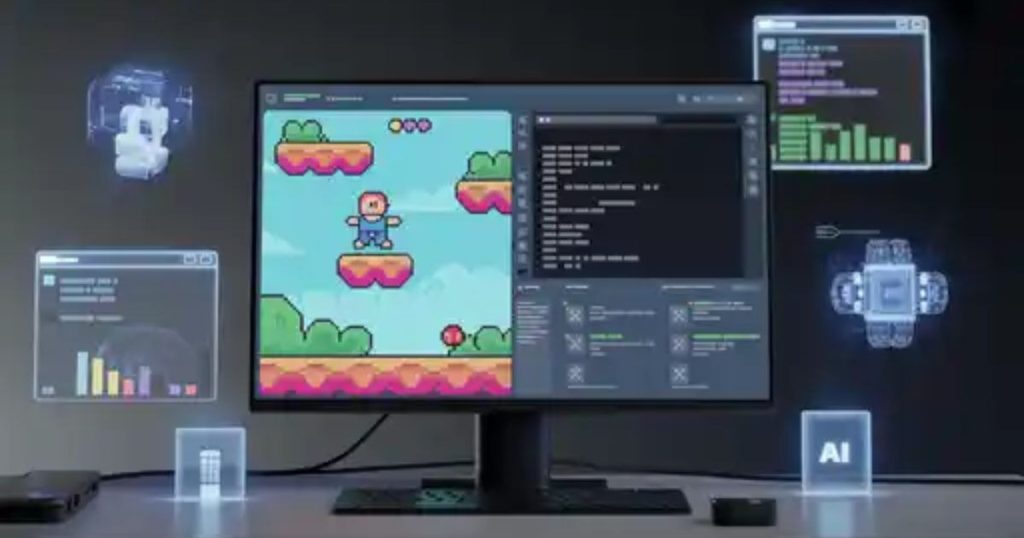
Rethinking Time: Making a game in one month. Today’s Game Development: Making Games) Programmers Building games is difficult, so it’s not surprising that development times have traditionally been measured in years. AI tools can now help with everything from generating game ideas to coding, designing levels, creating characters, and even playing games before launch.
Rather than working for months to master a complex programming language or to create every asset on the team, the creators can now use an AI-powered tool that simplifies the workload. It also means it’s easier to make games, not only for novices but also for those who are tough a few times. Whether you’re planning to publish a mobile game, a browser game, or even a larger gaming project, AI can certainly give you a helping hand.
Now, with advances in technology, game-making is becoming more democratized as everyone is turning their imaginative game ideas into playable games like Astrocade. New ways in which artificial intelligence is being utilized in gaming are predicted to continue to change the industry.
AI Development Benefits
A Unity game dev project manager who has been watching things all the way to the release of Unity’s AI solution. “Hands down,” one of the best things about AI software is that it lets game devs move faster. Traditional game development is resource-intensive , with months spent designing, coding, testing, and creating assets. The real enabler for teams to innovate and improve gameplay is that step-up in efficiency.
In addition, it brings cost savings since such complex work can be done with fewer hands. It’s only recently that the technology has matured and spread widely enough for small teams and indie developers to use it and potentially compete with the big studios. When workflows are made more productive and less monotonous, AI allows creators to bring their ideas to life faster and better than before.
Faster Design Process
Game design is a critical stage that determines what a player will do. Designers have to design mechanics, levels, goals, characters, and audiovisual styles that work well together to produce a quality game. AI platforms streamline this work by generating ideas and recommendations aligned with the project’s goals. Using AI, developers can also create full-fledged layouts, mission concepts, and gameplay mechanics in minutes.
These tips are great to use as is or to tweak further. AI is also deployed to identify trending gaming and player patterns to inform developers on what the audience may want. Instead of spending too much time brainstorming and plotting the entire story, AI allows creators to focus more on fleshing out their ideas. The rapid design process helps in preventing the project from stalling and enables the rest of the development team (designers, programmers, artists) to work efficiently whilst being creative and innovative throughout the process.
Smart Coding Solutions
Coding is probably the most challenging part of game development. Half the time, they’re confused about which programming languages to learn, how to debug errors, and how to get complex systems to work. AI software simplifies these procedures and provides intelligent code support. These make us more productive, both for noob and more experienced programmers.
Instead of writing repetitive code, game creators can focus on creative pursuits, building fun game experiences and fresh features that set their games apart from the competition. Beginners can also learn to better understand programming concepts by drawing on AI-based solutions and explanations. Not only does this help speed up learning, but it can also empower new developers.
Creative Asset Creation
Content-intelligent production leverages AI to shorten the time to content creation while maintaining quality. This is particularly great for smaller or non-existent art teams that will have indie devs. This means that by using AI to create assets faster, developers can focus more on gameplay and player engagement.
Audio could get AIfied too. Developers can create their own background music, sound effects, and voices without large-scale recording sessions or professional studios. Some tools are powered by AI to help you create mood-driven sounds or, for a given genre, produce the appropriate background music for your game.
Advanced Testing Methods
Since testing is so critical to a game running well and being fun, it can take a while. The conventional way of testing has the game’s developers working many long nights chasing down bugs, tuning gameplay, and testing performance. The process can be accelerated using AI software that automates some testing procedures. Intelligent systems can simulate a player, identify bugs, and generate detailed reports, including potential problems. With this, developers can address problems earlier in the development process.
Automated testing saves teams’ time and effort and helps maintain quality during production. 9 AI can also learn from player interaction and provide game design trends through player play. Using user features and their interactions across different component layers, AI-based platforms can identify potential elements that confuse or frustrate users.
Future Gaming Trends
Games may also evolve in real time, responding to player actions with future AI technology. Characters could respond smartly to user input, and game worlds might dynamically change based on what you like and what you don’t. The curated content will make gameplay more engaging and interactive. AI-powered analytics would give developers a clearer idea of what their audience needs, enabling them to create features that players feel connected to.
With the proliferation of such tools, more and more people with little or no technical know-how will be able to access powerful development tools. The future looks sunny for creators and gamers alike who want to build new kinds of games that reach global audiences through high-fidelity titles powered primarily by AI.
Conclusion
Developing a game in a fraction of the time it used to take, with similar quality, is now attainable thanks to AI software. From designing and programming to asset creation, testing, and more, AI-driven tools are enabling developers to work smarter and more efficiently across many aspects of game development. Creators can spend more of their time and energy on creativity rather than technical tedium, saving them time and money. Whether it’s a basic mobile game or a high-end interactive experience, a variety of content can be developed quickly and easily with AI, contributing to the earlier realization of ideas than ever before.
With all the advancements in AI technology, the possibilities for games are more diverse than ever. Beginners can turn their ideas into playable games without deep technical know-how, and expert programmers can also accelerate development and enhance creativity. If you want to make your own game like Brilliant Move, don’t miss this!
FAQs
What’s the simplest way to make a game using AI software?
AI software also includes options for programming, design, testing, and rendering assets. These frameworks allow developers to build games quickly and with fewer bugs.
Can I develop a game using AI software for non-reporting of skills?
Yes, AI tools help novices become developers by automatically generating code, offering design suggestions, and being easy to use.
How does AI speed up game development?
AI does the tedious work of programming, testing, and generating content so developers can focus on the fun of game development.
How come game developers need to work with AI?
With OpenAI tools, game development is faster, cheaper, more imaginative, and accessible to far more people.
An AI creates game levels, characters, etc.
In fact, you can use AI for character designs, level layouts, or really anything creative you can think of in game development.
Is AI the future of game development?
AI is becoming a vital game development technology, as it simplifies workflows, increases production efficiency, and fosters greater creativity.
